▲第一作者: 王文彬、王鈺棠和楊若歐;通訊作者: 華中科技大學翟天佑、劉友文和上海光源姜政
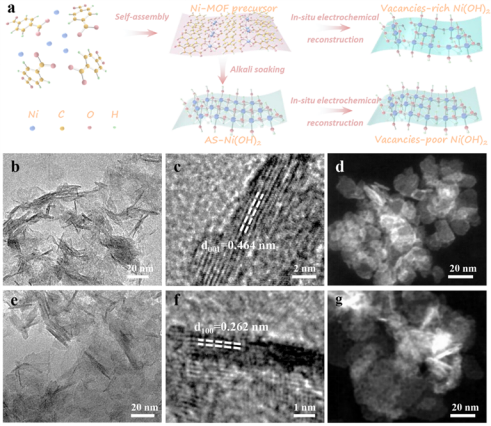
論文DOI:10.1002/anie.202005574近日,華中科技大學翟天佑和劉友文團隊與上海光源姜政研究員合作,通過空位調控Ni(OH)2納米片表面的電荷密度,實現了對氫氧化鎳電氧化伯胺的C-N鍵為腈C≡N鍵過程的性能優化。腈是化學和生物學中一類重要的含氮化合物。傳統的腈合成過程大多需要氰化物的參與或高溫條件,無法滿足可持續發展的要求。電催化伯胺脫氫制腈提供了一種清潔、簡單、有效的獲取腈的方法,在工業、農業、醫藥領域具有很大的應用價值。但是,目前對于C-N鍵到C≡N鍵的轉化過程并沒有進行詳細的探究,其轉化機理和性能優化還未受到關注。我們的工作從胺的結構出發,考慮到伯胺的氨基(-CH2-NH2)中,-NH2是采用不等性sp3雜化,其N原子周圍存在孤對電子從而表現出電子聚集。因此,可以通過在催化劑表面構建貧電子位點去化學吸附N原子中的孤對電子并進一步攻擊N-H鍵活化正丙胺分子。在此思路下,我們提出利用空位工程誘導催化劑表面產生貧電子位點,以期實現對伯胺電氧化性能的優化。▲Figure 1. Preparation and characterization for the vacancies-rich (VR) and vacancies-poor (VP) Ni(OH)2 atomic layer. (a) Schematic illustration of controllably synthesized of VR-Ni(OH)2 and VP-Ni(OH)2. (b-d) TEM, HRTEM and HAADF-STEM image of the VP-Ni(OH)2, respectively. (e-g) TEM, HRTEM and HAADF-STEM image of the VR-Ni(OH)2, respectively.
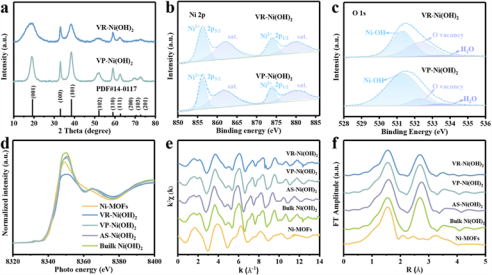
以Ni-MOFs超薄納米片為前驅體,通過原位電化學拓撲轉換實現了富空位Ni(OH)2納米片的成功合成。同時,采用合成富空位Ni(OH)2納米片的方法處理 Ni(OH)2前驅體,獲得了貧空位Ni(OH)2納米片,且通過原位電化學拓撲轉換獲得的富空位Ni(OH)2和貧空位Ni(OH)2均能保持片狀形貌。▲Figure 2. The characterization for vacancy. (a) XRD patterns. (b) XPS Ni 2p spectra. (c) XPS O 1s spectra. (d) Ni K-edge XANES spectra. (e) Ni K-edge EXAFS k3(ck) oscillation functions and (f) the corresponding FT curves
借助同步輻射X射線吸收精細結構光譜和X射線光電子能譜研究了富空位Ni(OH)2納米片的電子結構。結果顯示,原位電化學前后,Ni的化學態未發生明顯變化,均為+2價。而且,與商業Ni(OH)2和Ni(OH)2前驅體相比,富空位Ni(OH)2和貧空位Ni(OH)2的白線峰有明顯下降,其中富空位Ni(OH)2的下降幅度更大,下降程度更大,這意味著Ni原子周圍的幾何局部結構(例如配位數、鍵長)已發生微小的變化。通過最小二乘曲線擬合,富空位Ni(OH)2的擬合Ni-O、Ni-Ni配位數遠低于Ni(OH)2前驅體和貧空位Ni(OH)2,證明了富空位Ni(OH)2中存在著大量的氧空位和鎳空位。
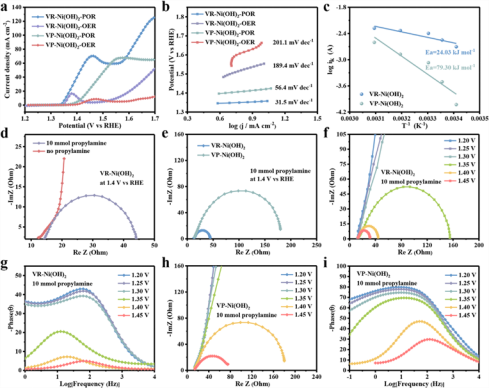
▲Figure 3. Electrochemical measurement. (a) The normalized polarization curves and (b) the corresponding Tafel plots. (c) Arrhenius plot. (d) Nyquist plots for VR-Ni(OH)2 in 1m KOH with and without 10 mmol propylamine at 1.4 V (vs RHE). (e) Nyquist plots for VR-Ni(OH)2 and for VP-Ni(OH)2 catalysts in 1 M KOH with 10 mmol propylamine at 1.4 V (vs RHE). (f) The corresponding Nyquist plots and (g) Bode phase plots of VR-Ni(OH)2 at various voltages in 1 M KOH with 10 mmol propylamine. (h) Nyquist plots for VP-Ni(OH)2 and (i) Bode phase plots of VP-Ni(OH)2 at various voltages in 1 M KOH with 10 mmol propylamine.
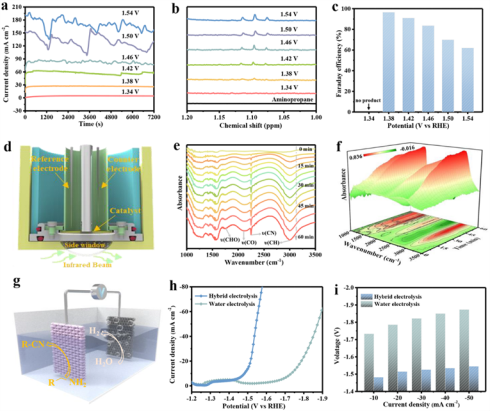
以正丙胺為例,研究了富空位Ni(OH)2和貧空位Ni(OH)2的電催化伯胺性能。電化學測試表明:受益于富空位Ni(OH)2具有較小的正丙胺活化動力學勢壘、更好的電導率和更快的電荷轉移速率,富空位Ni(OH)2展現出了最優的正丙胺氧化性能,即起始過電位明顯下降、 Tafel斜率減小、電流密度顯著增加。▲Figure 4. Detection of product and coupling electrolytic water performance. (a) Chronopotentiometric curves of VR-Ni(OH)2 at different potentials in 1 M KOH with 10 mmol propylamine. (b) 1H NMR spectra of the collected product at different potentials. (c) FEs of propionitrile at different potentials. (d) The schematic showing the setup for the in-situ IR experiments. (e, f) in situ FTIR spectra for propylamine electrooxidation of VR-Ni(OH)2. (g) The schematic showing the homemade propylamine electrolyser using VR-Ni(OH)2 as the anode and CoS2-MoS2 as the cathode. (h) Current–potential curves in a two-electrode system in 1.0 m KOH with and without 10 mmol propylamine. (i) The voltage of the electrolyzer required for different current densities
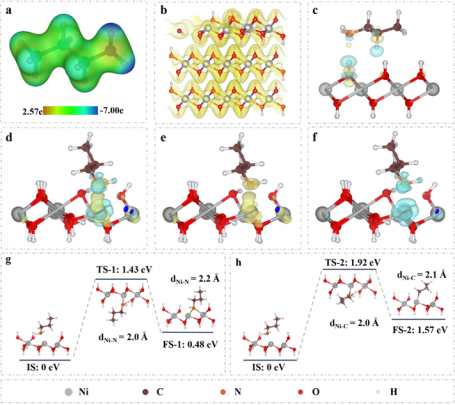
利用核磁共振氫譜和原位傅里葉變換紅外光譜對正丙胺氧化產物進行表征。結果表明:丙腈是正丙胺電氧化的主要產物,實現了伯胺到腈的轉化。結合電化學性能測試和對氧化 產物的分析,證明了富空位Ni(OH)2納米片是正丙胺氧化為丙腈的有效催化劑。▲Figure 5. Theoretical simulation. (a) Electrostatic potential maps of propylamine. (b) Charge density of the VR-Ni(OH)2. (c) The charge density difference in the perfect Ni(OH)2 and the isosurfaces level is 0.000968 au. The yellow and blue isosurfaces represent charge accumulation and depletion in the space. (d) The charge density difference in the VR-Ni(OH)2 and the isosurfaces level is 0.004028 au. (e) The positive charge density difference in the VR-Ni(OH)2. (f) The negative charge density difference in the VR-Ni(OH)2. (g) The reaction route 1 of propylamine electrooxidation. (h) The reaction route 2 of propylamine electrooxidation.
為揭示Ni(OH)2的空位缺陷與正丙胺吸附之間的關系,進行了理論計算。結果表明,空位缺陷的存在為富空位Ni(OH)2提供了正電荷表面,從而可以通過吸引孤對電子直接化學吸附正丙胺分子。而理想的Ni(OH)2需要高達2.59 eV的能壘才能形成表面空位缺陷,進而有效吸附正丙胺。同時通過計算了解了電催化正丙胺轉化為丙腈的機理并確定第一個脫氫位置,正丙胺的N原子更容易被具有空位缺陷的Ni(OH)2表面上的缺陷Ni原子捕獲,然后攻擊相應的N-H鍵。我們通過原位電化學拓撲轉換Ni-MOFs前驅體,可控合成了富空位Ni(OH)2。結合實驗和理論計算結果分析表明,空位的存在誘導了Ni(OH)2表面產生貧電子位點,從而化學吸附N原子中的孤對電子而攻擊N-H鍵去活化正丙胺分子,使得富空位Ni(OH)2表現出了較優的正丙胺氧化為腈性能。我們這項工作從原子結構出發,探究了電荷分布對化學鍵活化過程的影響,也為其它化工產品的高效轉化提供了借鑒。