
羧酸酯一般來說較易被還原伯醇,其常用的方法為金屬鈉和醇 Na-EtOH;金屬氫化 物如氫化鋁鋰(LAH), 硼氫化鈉(鉀)等。其中金屬氫化物是為常用的還原劑。
本反應(yīng)是將羧酸酯用金屬鈉和無水醇直接還原生成相應(yīng)地伯醇,主要用于高級(jí)脂肪 羧酯的還原。
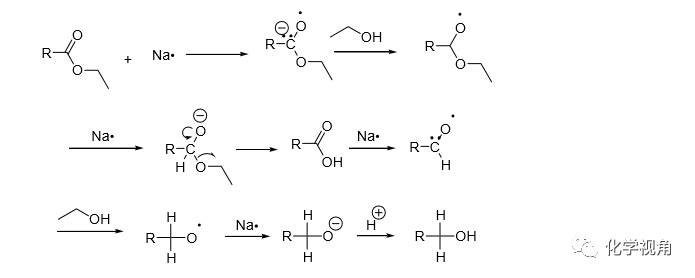
由于催化氫化和氫化鋁鋰的廣泛應(yīng)用,此法在實(shí)驗(yàn)室中已經(jīng)很少采用,但是因?yàn)槠?簡便易行,在工業(yè)上仍然廣泛應(yīng)用。Bouveault-Blanc 反應(yīng)的歷程可能如下:
金屬鈉和醇為還原劑(Bouveault-Blanc 反應(yīng))示例

The central neck of a 5-l. three-necked round-bottomed flask is fitted with a stopper carrying a mercury-sealed mechanical stirrer. One of the side necks is connected by means of a short piece of heavy rubber tubing to a large reflux condenser about 2 m. long, with an inner tube 2.5 cm. in diameter. The third neck is fitted with a separatory funnel.
In the flask are placed 70 g. (3 moles) of sodium and 200 cc. of dry toluene. The flask is heated in an oil bath until the sodium is melted. The stirrer is then started; when the sodium is finely divided, the oil bath is removed and the mixture allowed to cool. Stirring must be continued during the cooling in order to keep the sodium finely divided.
When the mixture has cooled to about 60°, there are added from the separatory funnel, first, a solution of 114 g. (0.5 mole) of ethyl laurate in 150 cc. of absolute alcohol, then 500 cc. more of alcohol, as rapidly as is possible without loss of material through the condenser. The time required for the addition of the ester solution and the alcohol is less than five minutes, usually two or three minutes. When the reaction has subsided, the flask is heated on a steam bath until the sodium is completely dissolved. The mixture is then steam-distilled to remove the toluene and ethyl alcohol. The contents of the flask are transferred to a separatory funnel while still hot and washed three times with 200-cc. portions of hot water to remove the sodium laurate. The lauryl alcohol is extracted with ether from the cooled mixture and the washings. The combined ether extracts are washed with water, sodium carbonate solution, and again with water, and dried over anhydrous magnesium sulfate. The ether is evaporated and the lauryl alcohol distilled under diminished pressure. The yield is 60–70 g. (65–75 per cent of the theoretical amount) of a product boiling at 143–146°/18 mm. or 198–200°/135 mm.
2.金屬氫化物為還原劑
羧酸酯用 0.5 mol 的氫化鋁鋰還原時(shí),可得到伯醇。
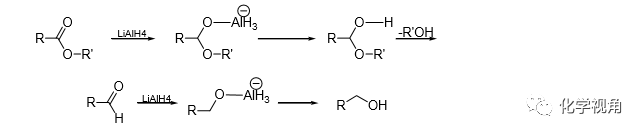
如僅用 0.25mol 并在低溫下或降低氫化鋁鋰的還原能力,可使反應(yīng)停留在醛的階段。
降低氫化鋁鋰還原能力可以提高還原反應(yīng)的選擇性。常用的的方法是加入不同比例 的無水三氯化鋁或者加入計(jì)算量的醇,取代氫化鋁鋰中 1-3 個(gè)氫原子而成鋁烷、或烷氧 基氫化鋁鋰。如用烷氧基氫化鋁鋰還原α,β-不飽和酯到α,β-不飽和醇,若單用氫化鋁 鋰還原,則得到飽和醇。
單純使用氫化硼納納還原酯效果較差,若在 Lewis 酸如 AlCl3,ZnCl2 存在下,還原 能力大增,可順利的還酯,甚至可還原某些羧酸。
由氫硼化鈉和酰基苯胺在α-甲基吡啶中反應(yīng),生成的酰苯胺氫硼化鈉是還原酯的 有效試劑。其優(yōu)點(diǎn):反應(yīng)操作簡便,不需要無水條件,反應(yīng)選擇性好。
LAH 還原羧酸酯成伯醇示例
利用 LAH 還原羧酸酯到伯醇是一個(gè)快速,后處理較為簡便的方法,一般情況下, 酯基可在零下 30℃下反應(yīng) 30 分鐘即可被還原。因此即使分子內(nèi)有酰胺或其他一些敏感的官能基存在也沒什么關(guān)系。

A dry, 500-mL, three-necked, round-bottomed flask is equipped with a 150-mL pressure-equalizing addition funnel, a reflux condenser topped with an inert atmosphere line, a glass stopper, and an egg shaped magnetic stirring bar. The flask is charged with lithium aluminum hydride (2.66 g, 0.070 mol) and anhydrous ether (50 mL). The flask is cooled to 5°C in an ice-water bath. A solution of (2R)-methyl 4-(tert-butyldimethylsilyloxy)-2-(dimethylamino)cyclohex-3-enecarboxylate (22.4 g, 0.072 mol) in ether (80 mL) is transferred to the addition funnel and added over a 30-min period. The reaction mixture is stirred for another 15 min, diluted with ether (100 mL), and quenched by dropwise addition of water (9 mL). The ice-water bath is removed, the resulting gray suspension is allowed to reach room temperature, and the mixture is stirred vigorously for an additional 60 min. The mixture is transferred to a 1.0-L Erlenmeyer flask and diluted with 350 mL of ether. Anhydrous sodium sulfate (Na2SO4) (60 g) is added, the suspension is stirred for 30 min, and filtered. The filter cake is washed twice with ether (50 mL each time). The solvent is removed on a rotary evaporator and the remaining volatile material is removed under high vacuum to afford 18.6 g (91%) of ((2S)-4-(tert-butyldimethylsilyloxy)-2-(dimethylamino)cyclohex-3-enyl)methanol as a viscous clear oil.
異丁醇鋁還原α,β-不飽和酯到α,β-不飽和醇示例

To a solution of 3-(1H-benzoimidazol-5-yl)-acrylic acid methyl ester (50 mg in 1 ML dry tetrahydrofuran) at -78.deg. C. was added 1.24 NL of a 1M solution of lithium tri-sec-butylborohydride in tetrahydrofuran and the mixture stirred at -78.deg. C. for 4 hours followed by warming to -40.deg. C. for an additional 4 hours。
The reaction was quenched by addition of aqueous methanol, concentrated in vacuo and purified by flash chromatography on silica gel (methylene chloride:methanol, 87:13) to give the title compound (44 mg).
硼氫化鈉(鉀)還原羧酸酯成伯醇示例
利用硼氫化鈉(鉀)還原羧酸酯到伯醇操作較為安全,簡單的方法,由于硼氫化鈉的還原性不夠強(qiáng),因此這類反應(yīng)一般需要回流過夜。反應(yīng)初始階段不要去加熱,而是在室溫下攪拌數(shù)小時(shí)后在,再加熱緩緩回流,否則反應(yīng)極容易噴出來。硼氫化鈉在甲醇中 分解較快,這個(gè)反應(yīng)盡量不要用甲醇做溶劑。

To a stirred suspension of 58.5g (300mmol) of dimethyl pyridine-2, 6-dicarboxylate in 800ml of anhydrous ethanol was added in portions 53.0g (1400mmol) of sodium borohydride at 0°C, after stirring for 1h at 0°C, the ice bath was removed and the ongoing exothermic reaction caused the solution to boil under reflux. Stirring was continued for 3h, then the solution was heated under reflux for another 10h. The solvent was distilled off and the residue was digested with 200ml of acetone. The acetone was distilled off; to the residue was added 200ml of a saturated aqueous solution of K2CO3 and the whole was heated for 1h with a boiling water bath. The solvent was again distilled off, the residue was dissolved in 800ml of water, and sodium chloride was added in portions with stirring until a colorless precipitate was formed. The product was extracted three times, each time with 150ml of chloroform, the combined organic phases were dried with MgSO4 and filtered. The solvent was distilled off to give 37.8g (91%)of desired product as colorless needles
NaBH4-ZnCl2 還原酯示例

To a suspension of ZnCl2 (80.36 g, 0.591 mol) in dry THF (1000 mL), NaBH4 (11.2 g, 0.3043 mol) was added in portions at 0~5℃ under nitrogen. The mixture was stirred for 30 min at 20~25 ℃, The mixture was cooled to 0~5 ℃ and compound (S)-diethyl 2-(triisopropylsilyloxy)succinate (82 g, 0.2368 mol) was added dropwise at 0~5 ℃. Then the mixture was warmed to 55~60 ℃ and stirred for 18 hours. After confirming the completion of reaction by HPLC, The result reaction mixture was cooled to -15~-10 ℃. Water (213 mL) was added dropwise to quench the reaction at -15~-10 ℃. The reaction was aged for 3 h at 20~25 ℃. Charged celite (12.3 g) to the mixture and then the solid was removed by filtration. The filtrate was concentrated under vacuum to remove THF. And the filter cake was washed with CH2Cl2 (250×3 mL). The combined organic layers were washed with water (200 mL) and the mixture was separated and the organic layer was dried over Na2SO4. The solution was concentrated to give compound (S)-2-(triisopropylsilyloxy)butane-1,4-diol (44.68 g, 0.170 mol, yield 71.9%).